
Experimental Modal Analysis (EMA)
Modal analysis identifies the resonance frequencies, damping coefficients, and mode shapes of a structure.
An advantage of a modal analysis compared to single point excitation measurements is that the associated mode shapes can also be visualised.
Modal AnalysisMachines and structures running in resonance will almost always result in premature failure of machine parts and foundations. Every structure has one or more eigenfrequencies, or resonance frequencies, and it is critical that these do not coincide with the running speed of the machine. Why it matters
Identifying resonance frequencies and mode shapes helps you prevent fatigue issues, avoid cracked foundations, and reduce the risk of recurring vibration failures.
|
What we measure and why
|
|
Shift the resonance
Redesign or modify the structure so resonance frequencies move away from excitation frequency.
|
Increase stiffness or mass
Add structural elements to change stiffness, or adjust mass so operation no longer aligns with resonance.
|
Add damping or absorption
Increase damping using material changes, viscoelastic layers, or tuned vibration absorbers.
|
Modal Analysis
Machines and structures running in resonance will almost always result in premature failure of machine parts and foundations. Every structure has one or more eigenfrequencies, or resonance frequencies, and it is critical that these do not coincide with the running speed of the machine.
Excitation measurement, or impact test, determines dynamic stiffness and eigenfrequencies for a single component.
Modal testing is used for complex structures and can visualise associated mode shapes.
Results guide structural changes to shift resonance away from excitation forces.
Our solutionWhatever the situation, AVT Reliability BV (formerly Van Geffen Reliability) has an experienced team of vibration and structural dynamics experts who can correctly perform excitation measurements and modal analysis, and accurately interpret the resulting data. Core capability
Accurate measurement, reliable data interpretation, and clear insight into structural dynamic behaviour.
|
How modal analysis is performed
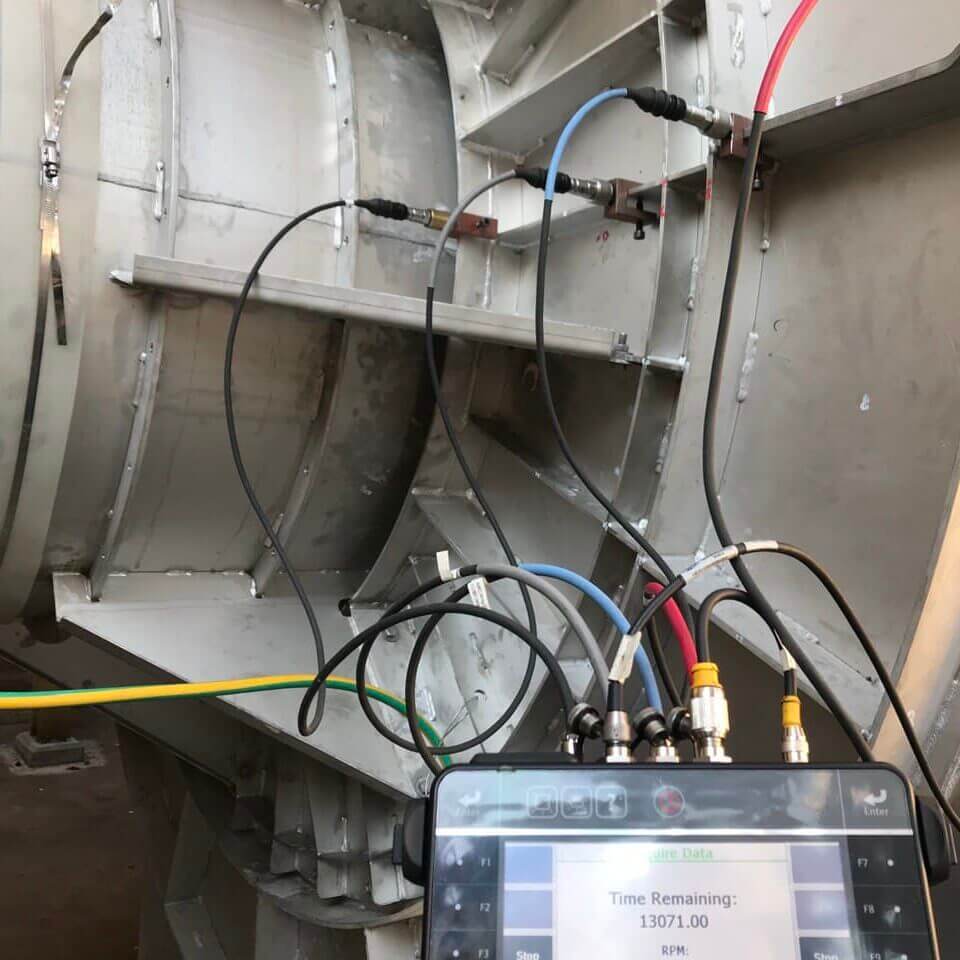
Excitation measurements and modal testing are often carried out on non-running machinery or structures. Modal analysis is traditionally performed by exciting the structure with a measured force using a force hammer or one or more shakers, while simultaneously measuring the response using accelerometers.
From measurement to insight
Using the combined measurement data, the Transfer Function or Frequency Response Function (FRF) can be calculated. Experimental Modal Analysis (EMA) has developed into a major technology for studying structural dynamics. Through EMA, complex structural behaviour can be represented using decoupled modes consisting of resonance frequency, damping, and mode shapes.
|
Our solution
Whatever the situation, AVT Reliability BV (formerly Van Geffen Reliability) has an experienced team of vibration and structural dynamics experts who can correctly perform excitation measurements and modal analysis, and accurately interpret the resulting data.
 |
Modal analysis and FEA simulationsExperimental modal analysis is a key measurement technique to identify and visualise resonance frequencies. The measured dynamic stiffness and mode shapes resulting from experimental modal analysis are often essential input for more complex Modal analysis is an important tool for identifying and solving structural vibration-related issues. A common problem occurs when an excitation function interacts with the resonance frequency of a structure. Any excitation will cause vibration, whether originating from rotational imbalance in a pump, reciprocating motion in a compressor, or from ambient sources such as wind, waves, offshore loading, or civil structures like bridges. When the frequency of excitation coincides with a resonance frequency, vibration levels can become excessively high, leading to structural fatigue and potential failure.
|
Modal analysis and FEA simulations
Experimental modal analysis is a key measurement technique to identify and visualise resonance frequencies. The measured dynamic stiffness and mode shapes are often essential input for
FEA (Finite Element Analysis) simulations to virtually engineer structural modifications.
Modal analysis helps identify vibration issues caused by interaction between excitation forces and resonance frequencies, whether from rotating equipment, reciprocating machinery, or ambient forces such as wind, waves, or traffic.
Offering
Single excitation measurements and modal testing have a wide range of applications. Based on our experience, these measurement techniques are commonly used for the following purposes.
|
Troubleshooting
|
Correlation with FEA models
|
Reduction of FEA models
|
Structural dynamic modification
|
|
Forced response prediction
|
Force identification
|
Sub-structural coupling
|
Active vibration control
|
Due to the properties of these measurement techniques, modal analysis investigations have broad applicability across industrial and civil engineering environments.
|
Quality control of rotor blades
By comparing measured resonance frequencies with theoretically determined values. |
Determination of dynamic stiffness
Applied to factory and laboratory floors. |
|
Annual testing of pedestrian bridges
Supporting research into structural damage detection. |
Mode shape analysis
Applied to compressor skids and similar structures. |
Offering
Single excitation measurements and modal testing have many applications, particularly in troubleshooting and structural optimisation.
Typical applications include:
Comparison of measured and theoretical resonance frequencies.
Assessment of factory and laboratory floors.
Supporting structural damage detection programmes.
Applied to compressor skids and similar assemblies.

Local service backed by global support
- 24 hours a day, 7 days a week, 365 days a year
- Clear detailed reporting with actionable insights
- Expert support and consultation
Local service backed by global support
- 24 hours a day, 7 days a week, 365 days a year
- Clear detailed reporting with actionable insights
- Expert support and consultation


