
Torsional Vibration Analysis/Testing (TVA)
Torsional vibration is an oscillatory angular motion that causes twisting in shaft sections and couplings of machinery.
These fluctuations are superimposed on the steady running speed. Sometimes the term torsional vibration analysis (TVA) is used to describe taking measurements but more commonly it refers to calculations performed with a computer program.
Torsional vibrationHigh torsional vibration typically presents as gear noise or coupling wear. Unlike lateral vibration, it is not usually detected by accelerometers or proximity probes commonly used for vibration monitoring. If torsional vibration issues are suspected, targeted measurements can be performed to determine the root cause. Computer-based analyses can then be used to evaluate and verify potential solutions before implementation.
|
Effects of excessive torsional vibration
|
Torsional vibration
High torsional vibration often presents as gear noise or coupling wear and is not usually detected by standard lateral vibration sensors such as accelerometers or proximity probes.
- High gear noise
- Accelerated gear wear
- Gear tooth failures
- Damaged couplings
- Key deformation
- Coupling hub slippage
- Motor winding loosening
- Shaft or coupling fatigue failure
When torsional vibration problems are suspected, dedicated measurements and computer-based analysis can be used to identify the cause and evaluate effective mitigation options.
Our solutionAVT Reliability BV (formerly Van Geffen Reliability) has extensive analytical and field measurement experience in addressing torsional vibration problems across all types of rotating and reciprocating machinery. Our approach combines targeted measurement techniques with advanced analysis to accurately assess torsional response under both steady and transient operating conditions.
|
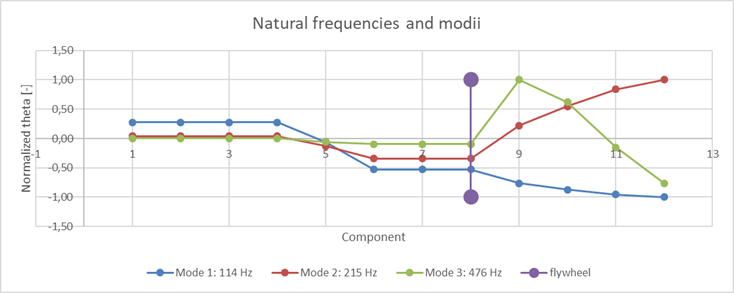
Frequency domain analysis
Used for steady-state operating conditions where system speed is assumed to remain constant.
Time domain analysis
Applied to transient operating conditions where speed or torque changes over time.
|
Our solution
AVT Reliability has extensive analytical and field experience in analysing torsional vibration issues across rotating and reciprocating machinery.
Used for steady-state conditions where system speed is constant, assuming continuous operation at each speed with constant dynamic torque excitation.
Applied to transient conditions such as startup through resonance or electrical fault events in motors.
 |
 |
 |
Offering
We provide a comprehensive range of services within the field of torsional vibration measurement and testing, supporting both investigative studies and long-term monitoring programmes.
|
Torsional vibration natural frequency measurement
|
Combined torsion and lateral vibration testing
|
Determination of torsional critical speed
|
|
Fatigue cumulative damage modelling
|
Torsional vibration monitoring
|
Verification of analytical models and Campbell testing
|
Depending on the application, site conditions, and practical constraints, several measurement techniques can be used to capture torsional or torque-related behaviour in the field.
|
Optical sensor technology
|
Wireless sensor technology
|
Strain gauge technology
|
Offering
We offer a wide range of torsional vibration measurement and testing services, supported by multiple field-ready measurement techniques.
Optical sensors, wireless sensors, and strain gauge technology are selected based on site conditions and application requirements.
Applications
A system’s inherent characteristics and specific operating conditions, including the torque effort curve, can cause or significantly influence torsional vibration behaviour.
Verifying torsional natural frequencies (TNFs) and vibration amplitudes is considered best practice for a wide range of rotating equipment.
|
Reciprocating gas compressors
|
Screw compressors
|
Plunger and centrifugal pumps
|
|
Centrifugal compressors
|
Internal gear (IG) compressors
|
Engine and generator sets
|
|
Engine–gearbox configurations
|
Long shaft or coupling systems
|
Large fans such as ID fans
|
- Any new combination of driver and driven equipment
- Changes in compressor configuration or significant changes in operating conditions
- Drive trains experiencing failures
- Variable frequency drive (VFD) applications
- Sensitive or critical systems
Applications
System characteristics and operating conditions can strongly influence torsional vibration behaviour. Verifying torsional natural frequencies and vibration amplitudes is recommended for many types of rotating equipment.
Field assessment recommended for:
- New driver or driven equipment combinations
- Configuration or operating condition changes
- Drive train failures
- VFD applications
- Critical systems

Local service backed by global support
- 24 hours a day, 7 days a week, 365 days a year
- Clear detailed reporting with actionable insights
- Expert support and consultation
Local service backed by global support
- 24 hours a day, 7 days a week, 365 days a year
- Clear detailed reporting with actionable insights
- Expert support and consultation


