
Vibration Investigation
Best practice of a multidisciplinary approach during vibration investigation. Working to gain insight into the source of increased vibration levels and enable a correlation between previously observed damage/abnormalities.
| Customer | Maritime |
| Location | Norway |
| Industry | Transport |
| Process | Power Generation |
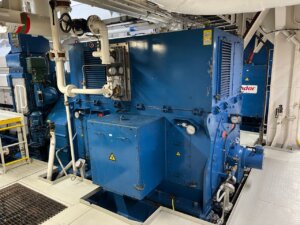
| Equipment | Diesel Engine driven Generator sets (4x 5 MW) |
| Products | 4 channel data collector, force hammer, motion amplification, ODS software |
| Services | Drawing up a measurement plan, physical execution of measurements and analysis & reporting |

The Challenge
On board this heavy load carrier there are 4 diesel engine-driven generator sets that supply power for the ship’s propulsion (electric propulsion) and the ballast system, among other things.
The vessel transports valuable cargo for the oil and gas industry (complete topsides) all over the world. A reliable energy supply on board such vessels has the highest possible priority.
 |
 |
 |
 |
Our Findings
For several years, an in-house condition monitoring program has been carried out on some ships of this shipping company with machine sentry (MSM + MSF). The crew itself carries out vibration measurements and inspections every month. AVT Reliability BV (formerly Van Geffen Reliability) carries out remote data analysis every quarter.
Since the program’s start, abnormal vibration behavior has been observed on 3 of the 4 generator sets on board 1 ship. On the other hand, the absolute vibration levels are still acceptable considering the applicable standards.
Our Approach
To gain better insight into the source of the problem, an engineer from AVT Reliability went on board for additional investigation
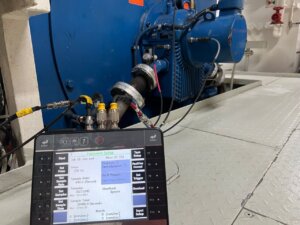
During this 2-day visit, the following measurements were carried out on all four generators:
- Transient measurements during run-up, heating/loading and run-down
- Tracking analysis (1st and 2nd order)
- Steady-state vibration measurements during FSNL (full speed no load) and FSFL (full speed full load) condition);
- Local excitation measurements with power hammer (resonance investigation)
- ODS (Operational Deflection Shape) measurements
- Motion Amplification Survey
Our Solution
The measurements revealed a structural problem with the generator skid. A natural frequency of the skid was excited by the 2nd order vibration component, resulting in a particular mode shape of the skid and increased vibrations around the generator.
Various cracks have been observed on and around the generators, which can reasonably be attributed to fatigue due to structurally high vibration levels.
Follow Up
Now that a structural problem has been identified, the most suitable structural solution will be determined via an FEA (Finite Element Analysis). The FEA models will be tuned with the data from the field measurements to obtain the most realistic model possible for further engineering.


