


Torsional Vibration Measurement
Discovering and confirming tooth hammering with the help of strain gauges.
| Customer | Industrial and medical gass Production |
| Location | Moerdijk (North Brabant in Netherlands) |
| Industry | Industry and health |
| Process | Air Compression |
| Equipment | E-motor driven centrifugal compressor |
| Products | Binsfeld TorqueTrak 10K |
| Services | Drawing up a measurement plan, physical execution of measurements and analysis & reporting |
Download PDF

Discovering and confirming tooth hammering with the help of strain gauges.
During commissioning of an e-motor driven centrifugal compressor at a new factory on site personnel noticed elevated vibrations and noise. VG Reliability were tasked with finding the cause of this deviation.
The Challenge
The asset is critical, it is used in the process of separating air. If this asset fails, production would stop with significant financial impact.
 |
 |
 |
Our Approach
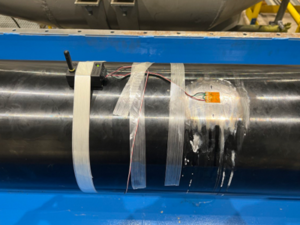
In order to review amplitude it is necessary to enter the exact material properties and dimensions of the shaft where the strain gauge will be applied.
The strain gauge is connected wirelessly (telemetry) to the measurement device (DAQ).
In this way we can continuously monitor the torque in the shaft with a sampling rate of 2400 samples per second.
Our Findings
We found torsional resonance frequency present at 11 Hz which causes tooth hammering at specific moment in the start sequence (for example synchronizing).
Due to the high vibrations the machine tripped. The customers team carried out modifications in the VFD configuration in order to reduce the vibration levels and they were able to fully start the machine.
The Solution
We recommend to compare our torsional vibration results with the Torsional Vibration Analysis (TVA) as created in the design phase and take further actions where needed.


